
Under the GDPR, a processor is a service provider that processes personal data on behalf of, and on the instructions of, another organisation. Hosting providers, SaaS vendors, marketing agencies and payroll firms are all examples. Article 28 requires a written contract that sets out the subject matter, duration and purpose of the processing, along with a list of specific obligations. This guide explains how to classify your providers, what the contract must contain and how to keep monitoring them over time.
Key takeaways:
- Whether you are a controller or a processor depends on the facts, not on what the contract says. A supervisory authority can reclassify the roles.
- You need a written contract or other legal act with every processor, and it must describe the actual security measures instead of copying out the GDPR.
- A processor can only engage a sub-processor with your prior written authorisation, which may be specific or general.
- If there is a data breach, the processor must inform you without undue delay. Your own 72-hour deadline to notify the supervisory authority then applies to you.
- Settle audits and what happens to the data at the end of the contract when you sign. Return or deletion is the controller's choice.
Table of Contents
- What is a processor under the GDPR?
- Processor, joint controller or independent controller: how do you decide?
- What must a GDPR data processing agreement contain?
- What obligations does the processor have in its own right?
- How do you choose and monitor a processor?
- Sub-processors: what should you authorise?
- What happens if a data breach occurs at the processor?
- End of contract: how do you get your data back or have it deleted?
- Yundera: shortening the chain of processors around your data
- The most common mistakes with processors
- Sources
- Frequently Asked Questions
What is a processor under the GDPR?
A processor is an organisation that processes personal data on behalf of and on the instructions of another organisation, the controller. The controller decides the purpose of the processing (why) and its essential means (how). The processor carries out the processing, and Article 28 requires it to act only on documented instructions from the controller. In a small or mid-sized business, you are almost always the controller for your customer and employee files, and your service providers are your processors.
- Hosting provider: stores your servers, databases and backups without deciding how they are used.
- CRM SaaS: processes your lead and customer records according to the settings you choose.
- Payroll provider: produces payslips from the employee data you send it.
- Email marketing tool: sends your campaigns to your contact lists.
- Managed IT services provider: administers your workstations and servers, and so has access to the data on them.
The contract alone does not settle who plays which role. According to the CNIL, France's data protection authority, the classification depends on the facts, not on a contractual choice, and the authority is not bound by what the parties write. Take an email marketing tool that reuses your lists for its own statistics or advertising: for that part of the processing it is acting on its own behalf. It becomes a controller for that use, even if its contract calls it a "processor".
Processor, joint controller or independent controller: how do you decide?
To decide, ask one question: who determines the purpose of the processing and its essential means? In other words, which data is processed, for what, for how long and who can access it. The answers point to one of three roles.
- Processor: the provider follows your instructions and only chooses non-essential technical means (software, server type). Your payroll firm and your hosting provider are examples.
- Joint controllers: two organisations set the purpose and means together, for example two companies that run a trade show and share a single attendee list.
- Independent controller: the provider pursues its own purpose. A chartered accountant bound by their own professional obligations is the textbook example.
The same provider can hold two roles at once. A SaaS vendor is a processor when it hosts your CRM. It becomes a controller for the part where it reuses your data for its own purposes, for example to improve its product or for its own marketing. Remember that the CNIL is not bound by contractual labels.
Each role has its own consequences. A processor requires a contract that complies with Article 28. Joint controllers sign an arrangement that allocates their obligations, as Article 26 requires. Two independent controllers are each answerable for their own processing. In every case, the controller must know all of its processors and sub-processors at all times.
What must a GDPR data processing agreement contain?
A GDPR data processing agreement (usually called a DPA, short for Data Processing Agreement) starts by describing the processing you are handing over. It then lists the obligations set out in Article 28(3) of the GDPR. The first part covers the subject matter, duration, nature and purpose of the processing, the types of data (identity, contact details, IBAN, health data and so on) and the categories of data subjects (customers, employees, prospects). The processor's commitments follow:
- a) Instructions: process the data only on documented instructions from the controller.
- b) Confidentiality: have authorised staff sign a confidentiality undertaking.
- c) Security: apply the measures required by Article 32.
- d) Sub-processing: meet the authorisation conditions and pass the same obligations down the chain.
- e) Data subject rights: help you respond to access, erasure, objection and other requests.
- f) Compliance: assist you with Articles 32 to 36 (security, breaches, impact assessments).
- g) End of contract: delete or return the data, as you choose.
- h) Audits: provide the information that proves compliance and allow audits and inspections.
You can negotiate these clauses freely or start from standard contractual clauses. A DPA that just copies out Article 28 does not protect you. Insist on a concrete security annex covering encryption, logging, backup frequency and access management. The CNIL also recommends using it to set out the rules for handling and reporting incidents.
What obligations does the processor have in its own right?
Some obligations apply to the processor directly, even if your contract is incomplete. It must process the data only on your instructions, secure the processing and help you meet your own obligations. The GDPR sets these out in Article 28 and Chapter IV.
- Following instructions: a payroll provider has no business reusing your employee files to test a new feature, or enriching them with other sources.
- Flagging unlawful instructions: it must tell you immediately if it believes one of your instructions breaches the GDPR, for example a request to keep CVs indefinitely.
- Security (Article 32): it puts in place measures suited to the risk, such as access control, encryption, tested backups and logging.
- Confidentiality: its employees and temporary staff who access the data commit to confidentiality in writing.
- Help with data subject rights: when a customer asks to access or erase their data, you must respond within one month. The processor must give you the exports or deletions you need in time.
The processor is also answerable for its own chain of providers. If its hosting provider or support tool falls short, the initial processor remains fully liable to you (Article 28(4)).
Pro tip: write a turnaround time for rights requests into the contract that is shorter than one month, for example 10 working days. That leaves you time to check the export before you reply to the person.
How do you choose and monitor a processor?
To choose a processor, check its guarantees before you sign, then keep monitoring it for as long as the contract runs. Article 28(1) says you may only use providers that provide sufficient guarantees, and it is up to you to show that they do. Here is a four-step method:
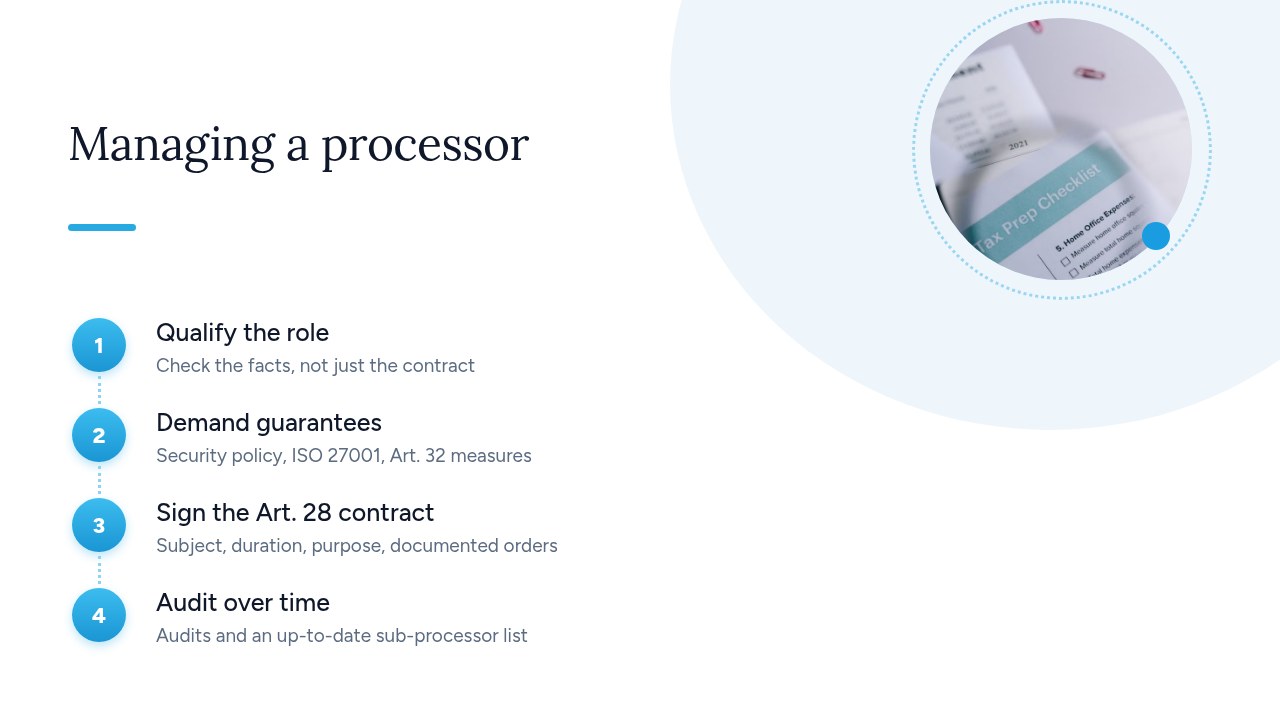
- Classify the role: check that, in practice, the provider acts on your behalf and not for its own purposes.
- Require guarantees: ask for its information security policy and any certifications. These might include ISO/IEC 27001 for security, ISO/IEC 27701 for privacy, or a health data hosting certification (such as France's HDS) if you entrust it with health data.
- Sign the Article 28 contract: the CNIL lists starting processing without a compliant contract among the practices to avoid. No signed DPA means no customer file import, even for a "trial period".
- Keep auditing: build verification into the contract, such as security audits or site visits. Every year, ask again for the list of sub-processors and for current certificates.
For a small business, a security questionnaire of around twenty questions is often enough to rule out weak providers. It might cover where data is hosted, encryption, two-factor authentication for administrators and how quickly you are alerted to an incident. Keep the answers: they prove your due diligence if you are ever inspected.
Pro tip: an ISO/IEC 27001 certification often covers only part of a company's activity. Ask for the certificate and its exact scope, and check that the service you are buying falls within it.
Sub-processors: what should you authorise?
Your processor can only hand all or part of the processing to another provider with your written consent. Under Article 28(2), it needs the "prior specific or general written authorisation of the controller". The two forms do not give you the same level of control.
- Specific authorisation: you approve each sub-processor by name. This gives you maximum control, but it gets cumbersome with a SaaS vendor that uses a dozen of them.
- General authorisation: this is the most common form. In return, the provider must tell you its list and any changes to it, so that you can object.
In practice, ask for an up-to-date list that gives the following for each sub-processor:
- Name and role: hosting, customer support, email delivery, backup, log analysis.
- Country of processing and access: hosting in the EU is not enough if support staff access the data from a third country.
- Data involved: all of your data or only metadata.
The provider can propose new sub-processors to you. But the CNIL points out that the decision to engage them and the responsibility for checking their guarantees always rest with the controller. So never let a change notification go by without looking at it.
Pro tip: changes are often announced on a web page or in a plain newsletter. Subscribe a shared mailbox (for example [email protected]) to these alerts. Also write into the contract a notice period before any change, and the right to terminate at no cost if you reject the new sub-processor.
What happens if a data breach occurs at the processor?
When a breach happens at your processor, the processor has to alert you, but you remain the one who must notify the supervisory authority. Article 33(2) is clear: "The processor shall notify the controller without undue delay after becoming aware of a personal data breach." The 72-hour deadline in paragraph 1 applies only to you, the controller, for notifying the authority. In practice, an alert that arrives on Friday evening about an incident detected on Tuesday leaves you almost no time.
The CNIL recommends setting out rules for handling and reporting incidents in the contract, with the controller informed "as soon as possible". At a minimum, specify:
- The channel and contacts: an address and phone number reachable 7 days a week, not just your account manager.
- A target deadline: for example 24 hours after detection, so you have time to analyse the incident before the 72 hours run out.
- The minimum content of the alert: the nature of the breach, the categories and approximate number of records and people affected, the likely consequences and the measures taken.
- Follow-ups: a commitment to send missing information as the investigation progresses.
The processor must then help you notify the authority and inform the people affected. In particular, it gives you the logs, the incident timeline and the list of affected accounts. For an hour-by-hour plan, see our guide Personal data breach: what to do within 72 hours.
End of contract: how do you get your data back or have it deleted?
When the service ends, the choice is yours: the processor must either return the data to you or delete it. Article 28(3)(g) says it must delete or return all the data as you choose and destroy existing copies. The only exception is a legal obligation that requires it to keep them. The text sets no deadline or format, so the contract has to.
- Export format: an open, documented format (CSV, JSON, SQL dump), including attachments and history, not just the main records.
- Deadline: for example 30 days to retrieve the export before final deletion.
- Certificate of deletion: a written document covering production, test copies and backups.
- Cost: state whether the export is included or billed, so it does not come as a surprise when you leave.
Test reversibility in the first year instead of waiting until you terminate. Run a full export and compare the record count with the one in the tool (wc -l clients.csv is enough for a first check). Also check that the attached files open. An export missing its attached documents is the most common pitfall.
Finally, record every change of provider in your record of processing activities. While you are at it, check that the returned data still respects your retention periods: getting ten years of history back does not entitle you to keep it.
Pro tip: backups are often overlooked. Have the contract state how long the provider's backups are kept before rotation (30, 90 days or more), because your data stays in them until they expire. The certificate of deletion should mention that date.
Yundera: shortening the chain of processors around your data
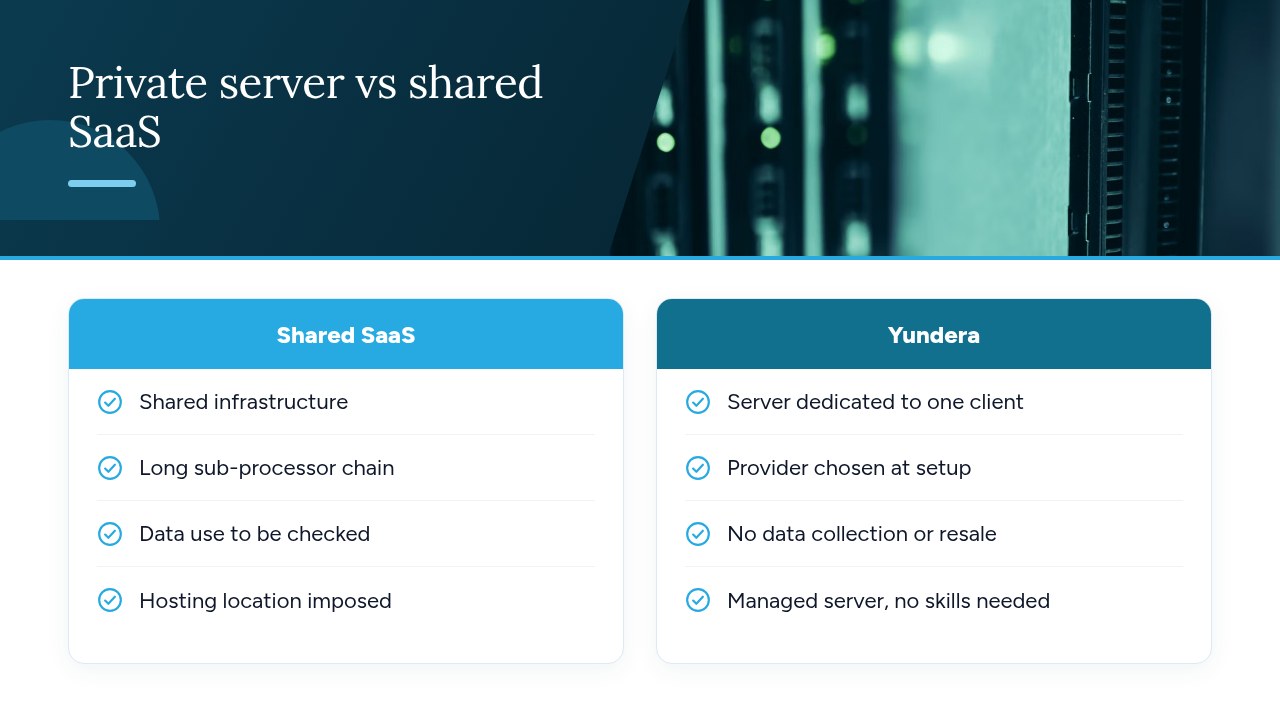
To shorten your chain of processors, bring your tools together on a server you control instead of stacking up SaaS subscriptions. Each new service adds a processor, often with its own sub-processors. You then have to classify it, sign a DPA, track its list of providers and check its exports, and the CNIL reminds controllers that they must know all of their processors and sub-processors. With five tools, the map quickly becomes hard to maintain.
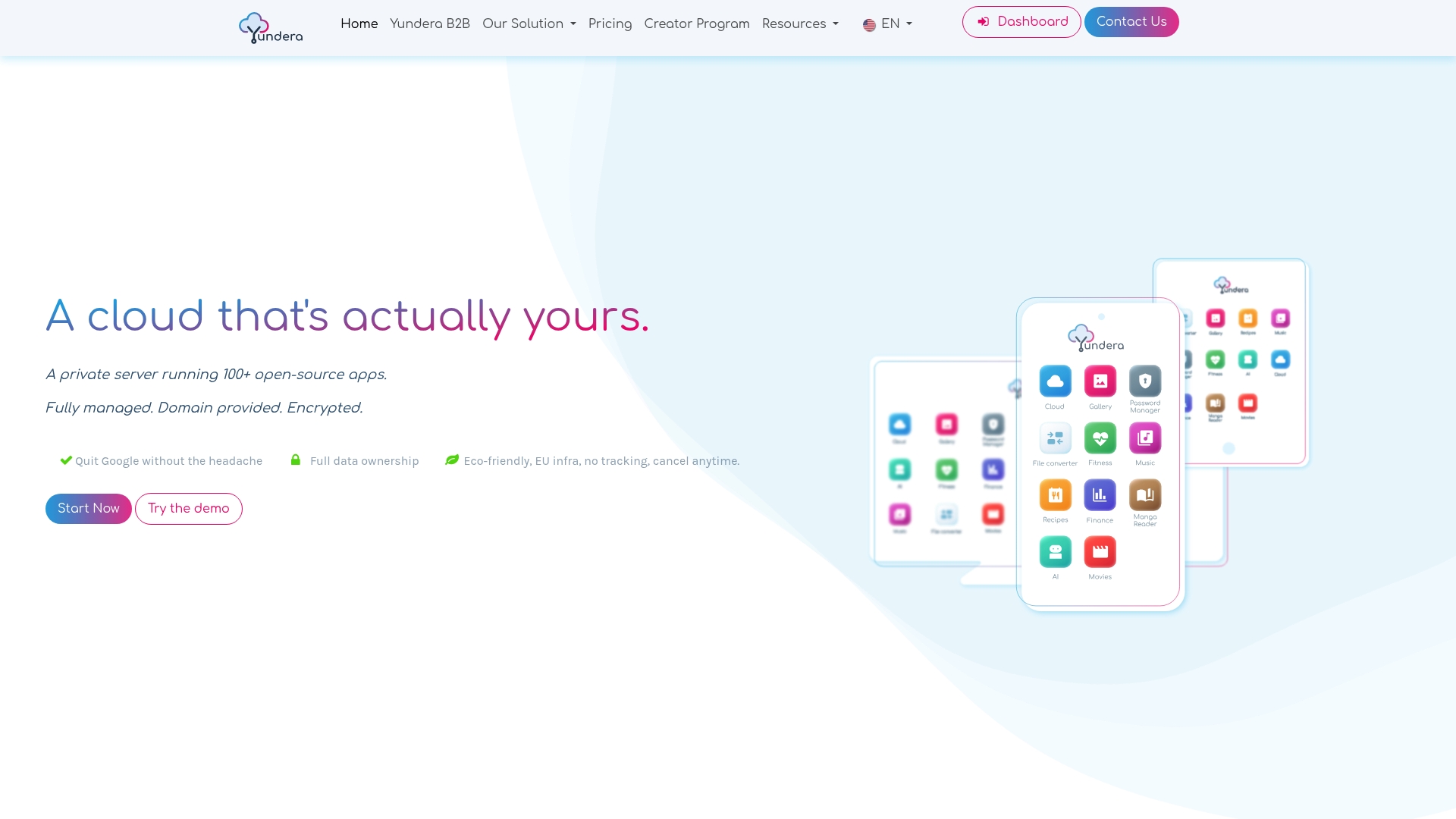
Yundera is one option. It provides a managed private server (Personal Cloud Server) dedicated to a single customer, with ready-to-use open source apps for file storage, photos, website hosting, office tools and more, each installed in one click from an app store. You choose the server provider when you set it up. Contabo is the main option, but Scaleway and others are also available. You therefore know which hosting provider to list in your record of processing activities, and you can review its data processing agreement. Your data stays on your server: Yundera does not collect it or sell it. Each app is available on your own domain over HTTPS, with no static IP, port forwarding or certificates to set up. No technical skills are required, since Yundera manages the server. You should still classify each party's role yourself in your GDPR documentation, as you would for any provider.
To see the available apps and how the service works, visit the Yundera private servers page. Prices are listed on the plans page.
The most common mistakes with processors
The most common mistake is handing data to a provider before signing a contract that complies with Article 28, which the CNIL lists among the things not to do. Other frequent mistakes include relying on the role written in the contract rather than the facts, accepting terms of service that copy out the GDPR without describing security, and letting updates to the sub-processor list go unchecked. Many organisations also forget to plan for audits, the incident procedure and the return of data at the end of the contract, and then fail to update their records.
Run through this checklist for every new provider:
- Role: check who actually sets the purpose and the means.
- Guarantees: get its security policy, its certificates and their scope.
- Contract: cover points a) to h), and include a 24-hour incident alert and an export format.
- Sub-processors: get the list, the countries involved and a right to object.
- Records: update the processing entry on the day you sign.
Sources
- Security: Managing subcontracting | CNIL
- Controller or processor: how to identify your role | CNIL
- Controller and processor: 6 good practices for respecting personal data | CNIL
- CHAPTER IV - Controller and processor | CNIL
Frequently Asked Questions
Is a hosting provider or SaaS vendor always a processor under the GDPR?
No. It is a processor as long as it processes your data on your behalf and according to your instructions. It becomes a controller for any part where it reuses the data for its own purposes, for example for its own marketing or to improve its product. The CNIL points out that the classification depends on the facts, not on the contract.
Is a GDPR data processing agreement (DPA) mandatory for a small business?
Yes. Article 28 makes no exception based on size: as soon as a provider processes personal data for you, you need a written contract or other legal act. A micro-business that uses an email marketing tool, payroll software and a hosting provider therefore needs three DPAs.
Can you accept a provider's terms of service instead of an Article 28 contract?
Yes, as long as those terms, or their DPA annex, include everything required by Article 28(3): subject matter, duration, purpose, types of data and obligations a) to h). Above all, check that they describe the actual security measures and the incident procedure, and do not just copy out the regulation. Keep the dated version you accepted.
Who is responsible if a data breach occurs at a processor?
The processor must alert you without undue delay. It is then up to you, the controller, to notify your supervisory authority within 72 hours and, where necessary, inform the people affected. The processor can also be held liable in its own right if it failed to meet its obligations, particularly on security.
How can I find out which sub-processors my provider uses?
Ask for the list in writing: under a general authorisation, the provider is required to tell you its list and any changes to it. Many vendors publish it on a dedicated page, often titled "sub-processors". Ask for the role and country of processing for each entry, and subscribe to update alerts.
GDPR Data Processors: Obligations and the Article 28 Contract