Guaranteed Export: Ethical Managed Web Hosting in France

Ethical web hosting is a service built around genuine data ownership: no collection, no resale, open source applications, and a guaranteed right to export your data at any time. For an individual, a family or a business handling sensitive data, a managed private server is usually the best option, because it combines that control with hands-on technical support. This kind of service is a useful benchmark for understanding what those guarantees actually mean in practice.
In short:
- Data sovereignty includes holding your own encryption keys and being able to migrate without depending on a provider — even when the server sits in France.
- US legislation such as the CLOUD Act can authorise extraterritorial access, which makes choosing a properly structured European infrastructure critical.
- Open formats and open source software make migration genuinely verifiable and avoid proprietary lock-in, unlike closed solutions.
- Ethical hosting requires a precise contract with an SLA, clear key management, encrypted backups and an export clause — especially for sensitive or regulated data.
- A managed private server, such as Yundera's offering, gives you full control over your data while sparing you the complex technical management of self-hosting.
Table of contents
- Data sovereignty: what the term really means
- Who needs ethical web hosting, and when?
- Managed hosting or self-hosting: which fits your situation?
- What should an ethical host guarantee contractually?
- How to guarantee your data stays exportable during a migration
- Which security practices keep hosting ethical over time?
- How Yundera's offering meets the criteria for ethical hosting
- Moving to a private server you genuinely own
- Sources
Data sovereignty: what the term really means
Sovereignty, residency and reversibility are often conflated. Residency tells you where your data is physically stored. Sovereignty goes further: it assumes you retain legal and technical control over your data, including possession of the encryption keys and the ability to migrate your infrastructure without depending on a provider. ANSSI's guidance on free software makes the point that without all three elements together, sovereignty remains incomplete — even if the physical server sits in France.
The US CLOUD Act allows American authorities to demand access to data hosted by companies subject to US law, even when the servers are located in Europe. That extraterritorial risk is precisely what a properly structured European infrastructure reduces. Tighter rules on transfers outside the EU since the Schrems II ruling are pushing more and more organisations to document exactly where their data lives.
Open formats and open source software act as a safeguard here:
- they prevent the proprietary lock-in that stops you from retrieving your data in a usable format;
- they allow independent code audits, unlike a proprietary black box;
- they make a genuine migration to another host possible when needed.
Who needs ethical web hosting, and when?
Not everyone faces the same stakes with their data. Here is how to place your own profile:
- The individual or family storing photos, personal documents or sensitive backups benefits from taking back control as soon as that content becomes large or valuable.
- The freelancer whose business depends on their website or digital tools needs to assess how reliant they are on leads generated online: a badly handled outage costs revenue directly.
- The company subject to regulatory obligations (healthcare, customer data, public procurement) must check its sensitivity thresholds before making any technical choice.
Cost and effort rise with the level of customisation you want, but a managed service flattens that curve for non-technical profiles.
Managed hosting or self-hosting: which fits your situation?
The choice mostly comes down to your tolerance for technical risk and the real value of your data. A badly configured self-hosted deployment — exposed ports, default keys, .env files accidentally committed to version control — remains a common vulnerability among those who dive in without support.
Managed hosting brings several concrete guarantees:
- support available in the event of an outage or security incident;
- service commitments (SLAs) formalised by contract;
- continuously managed security, without you having to track patches yourself.
Self-hosting, by contrast, offers total control over every technical building block and a direct cost that is often more variable — but it demands real system administration skills. For a company whose leads depend on its website, outsourcing operations directly protects revenue against costly downtime.
Pro tip: if you are torn, start by estimating what one hour of downtime on your site or files would cost. That figure alone usually settles the DIY-versus-managed debate.
What should an ethical host guarantee contractually?
Before signing with a host, a precise checklist avoids unpleasant surprises. Here are the points to insist on:
- A signed DPA (Data Processing Agreement) setting out export clauses and each party's responsibilities.
- Encryption key management: who holds the keys, and can you revoke them at any time?
- A written SLA, with accessible audit evidence — not just sales promises.
- The use of open source applications and a contractual clause ruling out any resale or collection of your data.
- Encrypted backups with regular restore tests, a clear retention policy and log anonymisation.
Certifications such as HDS, SecNumCloud or ISO 27001 serve a specific purpose: they become necessary for health data or public sector contracts, but they never replace a contractual exportability clause. A host can be certified and still lock your data into a proprietary format, which makes certification insufficient on its own.
Pro tip: always ask for a live demonstration of a data export before you sign, not just a theoretical clause in the contract.

How to guarantee your data stays exportable during a migration
Migrating without losing control takes method, not improvisation. Three steps structure a reversible migration:
- Prepare: confirm your data is stored in open formats, verify your access to the encryption keys, and put a dated backup plan in place before doing anything else.
- Execute: run the migration in parallel rather than switching over abruptly, check the integrity of the transferred files, and keep detailed logs of every step.
- Validate: perform a full restore test, inventory the migrated metadata, and keep an off-site snapshot in case something fails.
| Step | Key action | Expected outcome |
|---|---|---|
| Prepare | Check open formats and key access | No blocking dependencies identified |
| Execute | Parallel migration with logs | File integrity confirmed |
| Validate | Restore test and off-site snapshot | Reversibility proven, not just assumed |
A well-configured Nextcloud instance illustrates the principle nicely: open formats, modularity and native export make it a common foundation for this kind of sovereign project.
Which security practices keep hosting ethical over time?
Ethical hosting isn't proven once at contract signature — it is verified in day-to-day practice. Rigorous secrets management is part of that: tools like Vault, strict permissions on .env files and regular encryption key rotation all limit the risk of accidental exposure.
Hardening the infrastructure then comes down to simple habits that are too often neglected:
- security updates applied without delay;
- a properly configured firewall and reverse proxy;
- two-factor authentication or SSO applied across all administrator access.
Finally, logs deserve particular attention: anonymising them and enforcing a limited retention policy reduces exposure in the event of a leak. The most robust sovereign architectures go further and describe their entire infrastructure as code, using tools like Terraform or Ansible, which makes every technical component reproducible and auditable rather than dependent on a forgotten manual configuration.
Pro tip: schedule a quarterly restore test, even when nothing has gone wrong. A backup that has never been tested is a hypothesis, not a guarantee.
How Yundera's offering meets the criteria for ethical hosting
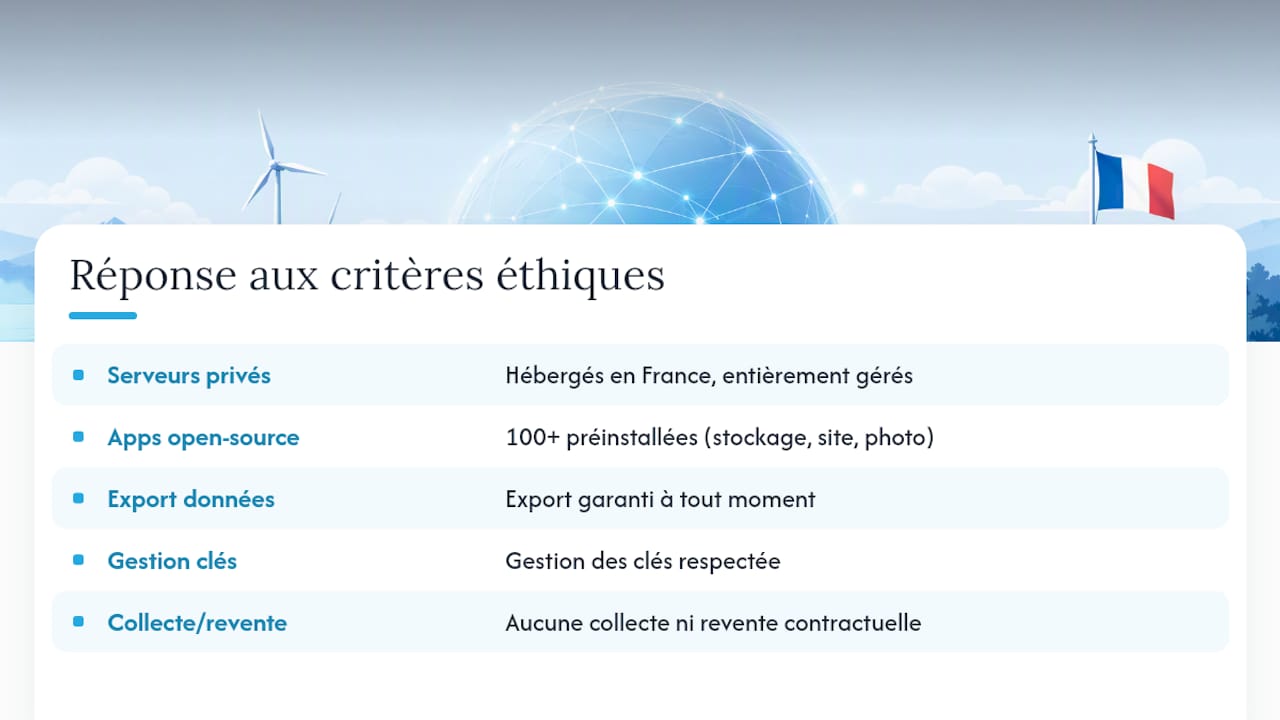
An offering built on customised private servers, fully managed and hosted in France, with more than 100 pre-installed open source applications, covers file storage, website hosting, photos and collaboration. This approach answers the criteria set out above directly: guaranteed data export at any time, key management respected, and a contractual commitment never to collect or resell user data.
For an individual or a company that wants to avoid the configuration mistakes typical of self-hosting without giving up control of their data, this kind of managed service bridges the gap between theoretical sovereignty and real-world use. Our guide to data sovereignty goes deeper into the legal criteria to check, and our comparison of self-hosted open source CMS platforms rounds out the picture for website projects.
— Yundera
Moving to a private server you genuinely own
This solution is an alternative to cobbled-together self-hosting for anyone who wants sovereignty without personally handling security patches, backups or network configuration.
Three benefits sum up what you gain in practice: full ownership of your data with no hidden clauses, the ability to export at any time without depending on a support team's goodwill, and access to more than 100 open source applications with no system administration skills required. The page dedicated to individuals and freelancers covers the offering for personal use, while the startups and SMEs page presents professional use cases and the savings available on IT infrastructure. You can review the available options right now and get started with a private server configured around your real needs, without a phase of technical tinkering.
Sources
- GDPR and international data transfers: the new post-Schrems II requirements — Mirabile Avocat
- Self-hosting n8n, GDPR and sovereignty — Tensoria
- Installing Nextcloud: sovereign cloud in 13 steps, 2026 — Tech-insider
Guaranteed Export: Ethical Managed Web Hosting in France