A Cloud With No Data Collection Is Possible: Here's How to Choose One

Yes, a cloud with no data collection does exist — under two specific conditions, one technical and one contractual. Either you self-host and encrypt your files yourself, or you choose a managed private server whose provider contractually guarantees both the absence of data collection and full exportability of your data. Before you sign anything, check three things:
- Who holds the encryption keys: you, or the provider?
- Is the no-collection policy written down in black and white, or merely implied in the marketing?
- Can you retrieve all of your data at any time, in a usable format?
If you are comfortable with system administration, self-hosting gives you maximum control. If you want something that works from day one without technical skills, a managed private server like Yundera's fits the bill — provided its guarantees are verifiable.
Key Takeaways
A genuinely collection-free cloud requires both encryption whose keys you keep and a contract that explicitly forbids any exploitation of your data.
| Point | Details |
|---|---|
| Check who holds the keys | Control of the encryption keys must stay in your hands — not just the encryption itself. |
| Demand exportability in writing | Ask for a contract guaranteeing a complete, immediate export of your data, with no hidden conditions. |
| Distinguish content from metadata | A service can refrain from reading your files while still collecting your connection and usage metadata. |
| Treat certifications as a signal, not as sole proof | SecNumCloud or HDS attest to a level of security, not to a commercial policy of non-collection. |
| Go for a managed server if you're not technical | Yundera offers a managed private server hosted in France, with a no-collection policy and guaranteed export. |
Table of Contents
- What a cloud with no data collection really means
- Self-hosting, managed server or zero-knowledge: which approach is right for you?
- What to ask before signing a cloud contract
- How to migrate your data without exposing your metadata
- The concrete proof behind a no-collection policy
- What the privacy talk leaves out
- Yundera: a managed private server built to collect nothing
- Sources
What a cloud with no data collection really means
The term is confusing because it covers several different realities. A provider may never read the contents of your files while still collecting your metadata: IP addresses, login timestamps, file sizes, search history within the interface. That metadata is often enough to reconstruct your habits without ever touching the content itself.
Three layers of data need to be told apart:
- User data: the actual content of your files, photos and documents.
- Metadata: who accesses what, when, and from where.
- Technical logs and telemetry: server logs and usage statistics sent to third-party servers for product analytics.
A "no-collection" cloud worthy of the name has to cover all three layers, not just the first. That is where the difference plays out between server-side encryption, where the provider holds the keys and can technically decrypt your files, and client-side encryption, where data leaves your device already encrypted and the provider physically has no way to read it.
The European data protection regulation imposes a principle of minimisation: a service must collect only what is strictly necessary for it to function. The CNIL spells out these requirements for cloud services and recommends encryption, restricted access, and a clearly defined log retention policy. This legal framework sets a floor, not a ceiling: nothing stops a provider from going well beyond the minimum obligations, nor from sitting just above them while remaining technically compliant. The trade-off is real, though: the tighter you lock down client-side encryption, the fewer features the provider can offer you — full-text search, automatic previews — since it literally sees nothing of what you store.
Self-hosting, managed server or zero-knowledge: which approach is right for you?
Three families of solutions let you avoid data collection, and they don't target the same kind of user.
-
Full self-hosting. You install software such as Nextcloud yourself, on your own hardware or on a server you rent, and you keep control over every setting. It is the only approach that removes the commercial middleman entirely. The open source tool ODK is a good illustration of this model: it can be deployed fully self-hosted, encrypts data in transit and at rest, and offers native export options. The downside is real: you become responsible for security updates, backups, service availability and troubleshooting when something breaks. An unpatched vulnerability on your personal server is your problem, and nobody else is going to fix it for you.
-
The managed private server. The provider handles the infrastructure, updates and maintenance, but you remain the owner of your data and your access keys. It is a middle ground designed for people who want control without becoming a system administrator. Contractual vigilance is still essential: you need to verify that the provider explicitly commits to not collecting your data, and not merely to "securing" it.
-
The zero-knowledge model. Here, encryption is structured so that the provider technically has no way to decrypt your files, even under legal compulsion. In practice, that means it cannot index your content, cannot train artificial intelligence models on your data, and cannot hand it over to a third party that asks for it. This architecture eliminates an increasingly common worry — seeing your personal files quietly feed the training of AI systems — a concern that comes up again and again among users explicitly looking for storage with no AI involved.
Pro tip: Combine the approaches rather than picking a single box. Encrypt your most sensitive files locally with an independent tool before uploading them, even to a managed private server with a solid no-collection reputation. You add a layer of protection that depends on no contractual promise at all.
What to ask before signing a cloud contract
A marketing promise of "privacy" is worth nothing without written proof. Here is what to insist on before paying for any subscription.
Always ask for the full privacy policy, the data processing agreement (DPA) and the technical log retention policy. A serious provider hands them over without fuss, often before you even ask. If it drags its feet or stays vague about how long logs are kept, that is an answer in itself.
On the technical side, check:
- Who manages the encryption keys, and whether you can generate or revoke them yourself.
- Whether encryption applies in transit and at rest, not just during the transfer.
- How long connection metadata is retained, and whether it is shared with subprocessors.
- Whether a full export of your data is available in one click, with no support ticket or imposed waiting period.
Certifications are a useful signal without being an absolute guarantee. The ANSSI's SecNumCloud framework qualifies secure and sovereign cloud offerings, and remains a serious benchmark for assessing a French host. For health data, the official list of HDS-certified hosts sets a specific bar. But a technical certification alone does not guarantee the absence of data collection: it attests to a level of security, not to a commercial policy of not exploiting your data.
Pro tip: Run a real test before committing long term. Upload a locally encrypted file, then try to retrieve or share it from another account on the same service. If the provider can technically decrypt it on your behalf without you having handed over a key, the no-collection promise doesn't hold up.
How to migrate your data without exposing your metadata
Switching cloud providers is often the moment when data is most exposed: files duplicated in the clear, connection histories multiplied, temporary logs left lying around on the old service. A four-step protocol limits that risk.
-
Inventory and categorise your files. Separate what is genuinely sensitive — contracts, personal data, financial documents — from what isn't. That way you avoid treating every single file with the same level of security effort.
-
Encrypt sensitive files locally before any transfer. Keep your encryption keys outside the service that will host the files. This is the step most users skip, even though it protects against a compromise of the provider itself.
-
Migrate in batches rather than in one massive operation. Transfer a limited set of files, check the access logs and the permissions applied on the new service, then carry on. That lets you spot a misconfiguration before it affects all of your data.
-
Document reversibility and test the export as soon as the migration is done. Don't wait until you urgently need it to discover the export doesn't work as promised. Run a dry test, time how long it takes, and keep a copy of the result.
This protocol takes barely longer than a standard migration, but it turns a risky operation into a controlled transfer.
The concrete proof behind a no-collection policy
A no-collection policy is only worth something if it translates into verifiable commitments. Yundera bases its approach on concrete elements rather than marketing formulas: infrastructure hosted in France, an explicit policy of not collecting or reselling data, guaranteed exportability at any time, and a broad suite of preinstalled open source applications covering file storage, website hosting, photo management and personal streaming.
That kind of guarantee should never remain a verbal promise. For it to hold up legally, it has to appear in the service contract, in a data processing agreement compliant with the GDPR framework, and ideally be backed by documented independent audits.
Regulatory compliance is a necessary foundation, but it is never sufficient on its own: it is the operational proof — real key management, effective access restriction, audit results — that makes the difference between a promise and a guarantee.
To dig deeper into the contractual obligations you should demand, our guide to GDPR compliance in the cloud goes through the clauses to check one by one, and our article on data ownership explains what a managed private server concretely changes in that relationship of trust.
What the privacy talk leaves out
The conversation around collection-free clouds almost always focuses on encryption, as if a good algorithm were enough to guarantee privacy. That's a misplaced focus. Encryption protects the content, but it says nothing about who manages the keys, how long connection metadata is kept, or whether the provider can be compelled to cooperate with a third party.

The real tipping point is key governance, not the mathematical strength of the encryption. A service can advertise flawless encryption while retaining the technical ability to decrypt everything server-side, which cancels out a good part of the promise.
For a non-technical reader, the realistic path isn't learning to administer a Nextcloud server at the weekend. It's demanding written proof from a managed provider — key control, guaranteed export, a contractual no-collection policy — and verifying that it holds up before signing. Yundera builds its offering on exactly these verifiable criteria, which makes it a relevant option for anyone who wants privacy without becoming an IT specialist.
— Yundera
Yundera: a managed private server built to collect nothing
For anyone who wants the control of self-hosting without shouldering the technical burden, Yundera offers a fully managed private server, hosted in France, with no data collection or resale at any point.
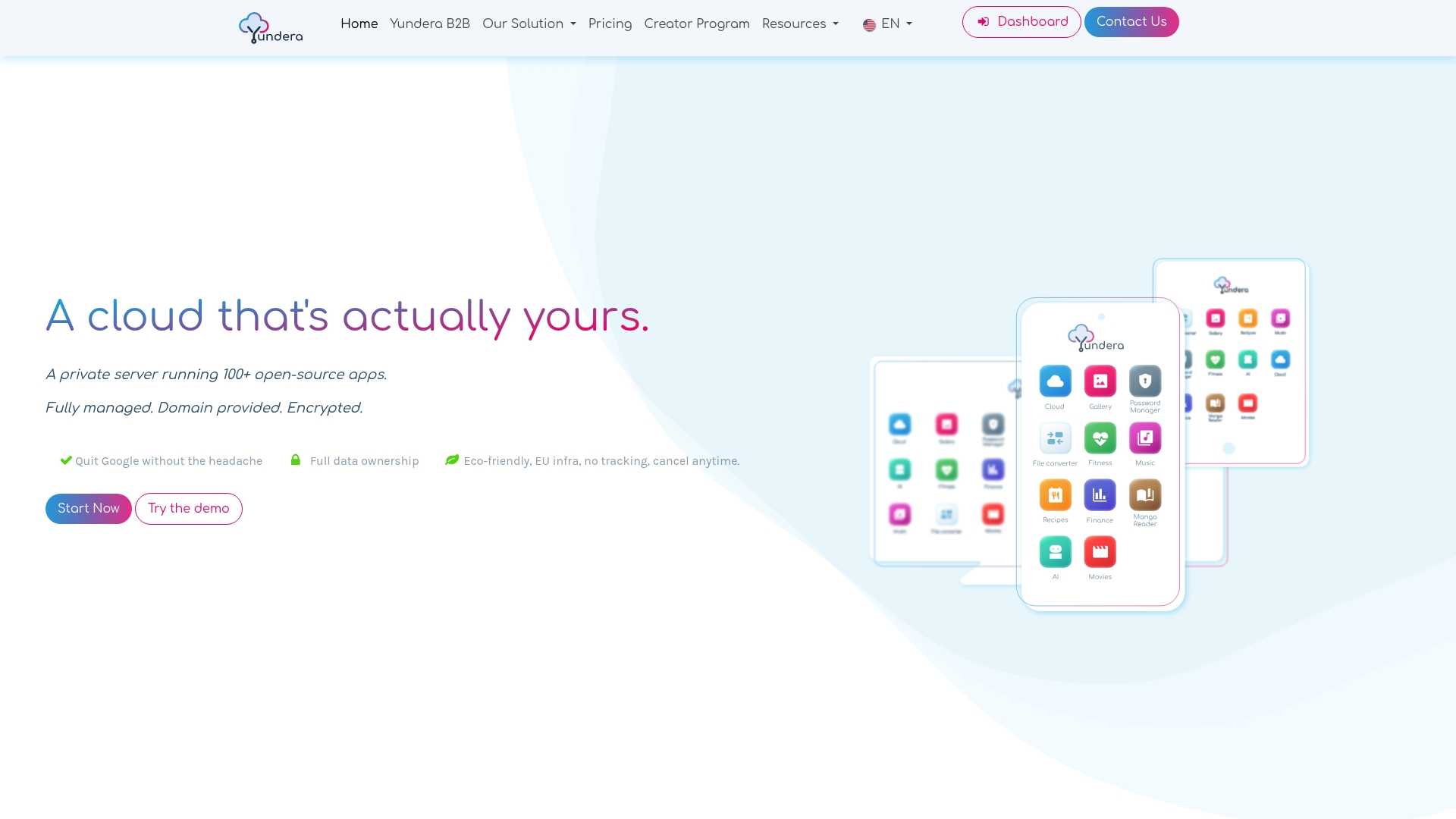
In practice, you get access to more than 100 open source applications — file storage, photo gallery, website hosting, password management, VPN — through a custom domain, without installing or configuring anything yourself. The team handles updates, security and availability, while you retain full ownership of your data, with export available at any time, for any reason. It's the opposite logic to a provider that locks you into its ecosystem: here, leaving is always straightforward. Freelancers and small organisations also find it a practical way to cut infrastructure costs, as our page on the benefits for startups and SMEs explains.
If you want to assess what this concretely changes for your own use, take a look at the page for privacy-conscious users and launch your own private server today.
Sources
- EUR-Lex (GDPR / related directive)
- CNIL: Security — Cloud computing
- ANSSI / SecNumCloud
- e-santé — list of HDS-certified hosts
- ODK — product documentation
A Cloud With No Data Collection Is Possible: Here's How to Choose One